
Our Works
True Wagyu Corporation


Semen Collection
We prepare our own custom dilution solution by mixing simple ingredients such as citric acid and fructose. Since our bulls are well-trained, their natural mounting behavior aligns smoothly with the moment we present the artificial vagina. This perfect timing ensures complete ejaculation, resulting in semen of excellent vitality.
Immediately after collection, the semen is cooled to 4 °C before dilution. Each straw is carefully filled by hand, without the use of machines. Throughout the entire process, we take great care to prevent any change in semen temperature.
As a result, semen frozen and thawed with this method shows remarkable vitality—flowing with the force of a rushing river. Because we rely only on the minimum necessary equipment, this process can be reproduced in any country and under almost any circumstances.
IVF Embryos


We extract oocytes from the ovaries of Wagyu cattle that would otherwise be discarded at slaughterhouses and produce approximately 5,000 Wagyu in vitro fertilized (IVF) embryos each year for transplantation. The primary recipients are Holstein dairy cows that have already calved, with an average conception rate of 55% for frozen embryos.
Through our proprietary sex-determination method, we are able to select male embryos, achieving a male ratio of 84%. Since dairy farmers cannot milk cows that have not calved, it has traditionally been common practice to produce F1 calves using Wagyu semen. However, we recommend transferring Wagyu embryos rather than relying on artificial insemination.
The price difference between F1 and fullblood Wagyu calves exceeds ¥200,000. For example, if 200 Wagyu calves are born, this represents an additional ¥40 million in annual revenue. Having dairy cows deliver Wagyu calves therefore provides a significant boost to dairy farmers’ income. Furthermore, because the embryos are fertilized with top Wagyu sires, the resulting calves have especially high market value.
Butcher Shop
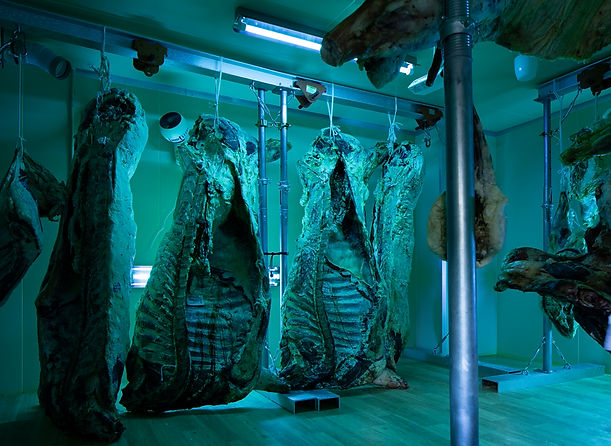
We are a butcher shop specializing in vintage beef.
Vintage beef comes from mature cattle aged four years or older, and we sometimes work with Japanese Wagyu mother cows as old as fifteen years.
Because the meat is naturally firmer, we use the traditional Japanese method of Karashi Jyukusei—hanging the whole carcass, bones included, for one to two months.
Aging in this way, under a UV-controlled sterile environment, develops extraordinary depth of flavor.
The result is beef with:
Intense umami
Rich, concentrated flavor
A long, savory finish
As a whole animal butcher, we value every part of the cow, offering a truly authentic vintage beef experience.